



Introduction
Compressed Biogas (CBG) plants are no longer viewed merely as renewable energy facilities; they are increasingly recognized as integrated sustainability and resource recovery projects. While the primary objective of a CBG plant is the generation of clean, renewable fuel, a substantial portion of the input material—often 40–50% of the total feedstock mass—emerges as digestate. This makes digestate management not a secondary activity, but a central pillar in the technical, environmental, and economic performance of a CBG project.
Digestate is the nutrient-rich residue obtained after the anaerobic digestion of organic waste such as agricultural residues, cattle dung, press mud, food waste, and municipal organic waste. When handled scientifically and processed appropriately, digestate can be converted into high-quality bio-manure, offering immense value to the agricultural sector. In the Indian context, where declining soil organic carbon, excessive use of chemical fertilizers, and rising input costs pose serious challenges to farmers, digestate-based bio-manure provides a sustainable and long-term solution.
From an environmental perspective, effective digestate management ensures a true circular economy model, where nutrients extracted from the soil through crops are returned back to the land, closing the nutrient loop. From a project developer and EPC standpoint, digestate utilization plays a crucial role in regulatory compliance, odor control, community acceptance, and additional revenue generation. Poor digestate handling can lead to environmental risks and social resistance, whereas a well-planned digestate strategy enhances project sustainability and financial viability.
As India accelerates its push towards renewable energy, waste-to-wealth initiatives, and sustainable agriculture under programs such as SATAT, Swachh Bharat Mission, and the National Bio-Energy Mission, digestate management emerges as a key enabler. Recognizing digestate not as waste but as a valuable by-product is essential for maximizing the overall impact of CBG plants.
What is Digestate?
Digestate is the nutrient-rich residual material obtained after the anaerobic digestion of organic feedstock within a biogas or Compressed Biogas (CBG) plant. During the anaerobic digestion process, organic materials such as agricultural residues, cattle dung, press mud, food waste, and municipal organic waste are biologically broken down by microorganisms in the absence of oxygen. While a significant portion of the carbon in the feedstock is converted into biogas—primarily methane and carbon dioxide—the majority of essential plant nutrients remain retained in the digestate.
In essence, digestate represents the stabilized organic fraction of the original feedstock, enriched with macro- and micronutrients that are vital for plant growth. Because the digestion process converts complex organic compounds into simpler, more plant-available forms, the nutrients present in digestate are often more readily absorbed by crops compared to untreated organic waste or even some conventional fertilizers.
Unlike raw organic waste, digestate undergoes biological stabilization inside the digester, resulting in several important improvements. The anaerobic process significantly reduces odor-causing compounds, minimizes the presence of weed seeds, and lowers pathogen levels, making digestate safer and more acceptable for agricultural use. Additionally, the reduction in volatile organic compounds improves handling, storage, and field application, especially in large-scale agricultural operations.
Digestate can be produced in both liquid and solid forms, depending on the feedstock characteristics and the post-digestion processing methods adopted by the plant. This flexibility allows digestate to be applied through various agricultural practices, including direct soil application, fertigation, composting, or conversion into packaged bio-manure products.
Composition of Digestate
The chemical and physical composition of digestate varies depending on several factors such as feedstock type, retention time in the digester, operating temperature, and digestion technology used (e.g., CSTR, plug-flow, or dry digestion). However, most digestates exhibit a consistent nutrient-rich profile that supports plant growth and soil health.
Macronutrients (NPK)
Digestate contains essential macronutrients required for crop productivity:
- Nitrogen (1.5–3%) – Present largely in ammoniacal form, making it readily available for plant uptake and supporting vegetative growth.
- Phosphorus (0.5–1.5%) – Essential for root development, flowering, and energy transfer within plants.
- Potassium (1–3%) – Improves crop resilience, water regulation, and disease resistance.
Organic Matter
Digestate retains a significant fraction of stabilized organic matter, which:
- Enhances soil organic carbon content
- Improves soil structure and aggregation
- Increases water-holding capacity
- Promotes long-term soil fertility
Micronutrients
In addition to NPK, digestate provides vital micronutrients, including:
- Calcium and Magnesium – Improve soil pH balance and plant metabolic functions
- Sulfur – Supports protein synthesis and enzyme activity
- Iron and Zinc – Essential for chlorophyll formation and enzyme activation
Moisture Content
- Moisture content typically ranges from 70–95% before processing, making raw digestate suitable for liquid application or fertigation.
- After separation, composting, drying, or pelletization, moisture levels are reduced, improving storage stability and transport efficiency.
Digestate as a Fertilizer Substitute
Due to its balanced nutrient composition, high organic matter content, and enhanced nutrient availability, digestate serves as a strong substitute or supplement to conventional chemical fertilizers. When applied correctly, it not only supplies nutrients to crops but also improves overall soil health, making agricultural systems more resilient and sustainable over the long term.
By converting organic waste into both clean energy and nutrient-rich bio-manure, digestate plays a pivotal role in closing the nutrient loop and reinforcing the circular economy model promoted by modern CBG plants.
Types of Digestate
Digestate can be broadly classified based on its physical form, moisture content, and post-treatment processes. This classification is essential for designing efficient storage systems, selecting appropriate handling equipment, determining application methods, and identifying potential commercial opportunities. Each type of digestate has distinct characteristics, advantages, and end-use applications in agriculture and soil management.
1. Raw Digestate
Raw digestate is the unprocessed slurry that is directly discharged from the anaerobic digester after biogas production. It contains a mixture of water, partially digested organic matter, microbial biomass, and nutrients.
Key Characteristics:
- Very high moisture content (typically 90–95%)
- Contains both solid and liquid fractions
- Nutrients present in mixed organic and inorganic forms
- Low odor compared to raw feedstock but still requires controlled handling
2. Liquid Digestate
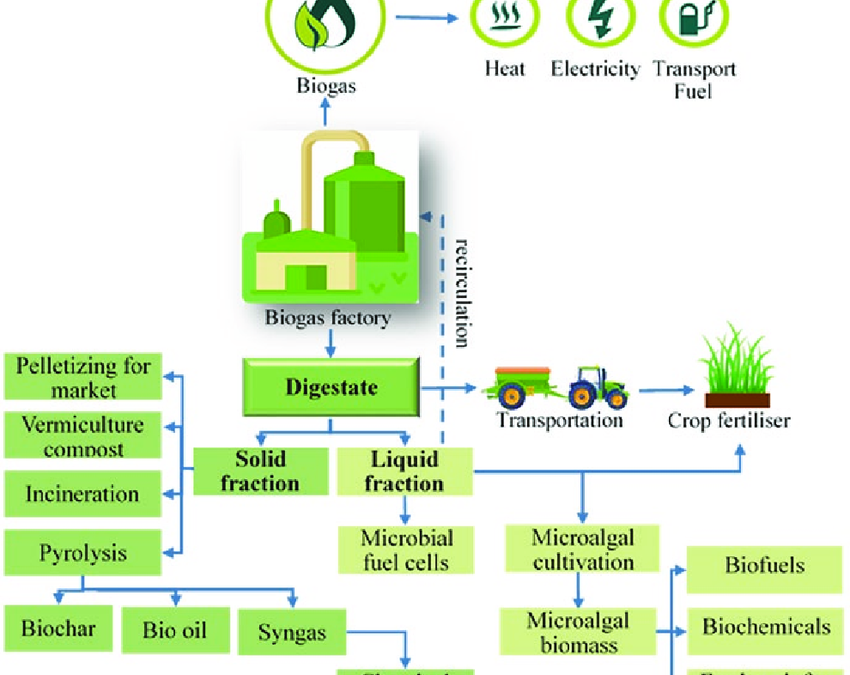
Liquid digestate is obtained after the solid–liquid separation of raw digestate using mechanical equipment such as screw presses, belt presses, or decanter centrifuges. The liquid fraction contains dissolved nutrients, particularly nitrogen in ammoniacal form, making it highly effective as a fast-acting fertilizer.
Key Characteristics:
- High nutrient solubility
- Rich in readily available nitrogen
- Low suspended solids
- Easy to pump and apply
Agricultural Applications:
Liquid digestate is widely used in:
- Fertigation systems through drip and sprinkler irrigation
- Direct field application in nearby agricultural lands
- Nutrient recycling in plantations, orchards, and fodder crops
Advantages:
- Rapid nutrient uptake by plants
- Reduces dependence on synthetic liquid fertilizers
- Ideal for farms located close to CBG plants
- Efficient utilization of nutrients with minimal losses when applied correctly
3. Solid Digestate
Solid digestate is the solid fraction separated from raw digestate. It has significantly higher dry matter and organic carbon content compared to the liquid fraction, making it suitable for further value addition.
Key Characteristics:
- Lower moisture content (typically 60–75% before drying)
- Rich in organic matter
- Improved physical structure
- Easier to store and transport than raw digestate
Processing Pathways:
Solid digestate is commonly:
- Composted to enhance stability, reduce moisture, and improve texture
- Dried and granulated or pelletized for uniform nutrient content
- Packed and branded as organic manure or soil conditioner
Each form of digestate serves distinct agricultural and commercial purposes:
- Raw digestate acts as an intermediate product for further processing
- Liquid digestate delivers quick nutrient availability and suits localized farming systems
- Solid digestate offers long-term soil improvement and strong commercial potential
Digestate Processing & Treatment Methods
- Digestate processing is a critical step in transforming raw digestate from a CBG plant into market-ready, compliant, and value-added bio-manure products. The choice of processing and treatment methods depends on several factors, including plant capacity, feedstock type, local agricultural demand, regulatory requirements, storage and transportation logistics, and targeted end users.
Solid–Liquid Separation
Solid–liquid separation is typically the first and most essential processing step in digestate management. Mechanical separation equipment such as screw press separators, belt filter presses, or decanter centrifuges is used to divide raw digestate into solid and liquid fractions.
Key Benefits of Solid–Liquid Separation:
- Reduced storage volume, minimizing tank and lagoon size requirements
- Improved handling and logistics, especially for long-distance transport
- Customized nutrient application, allowing liquid and solid fractions to be used according to crop needs
- Lower risk of nutrient runoff and leaching
The liquid fraction, rich in readily available nitrogen, is typically used for fertigation or nearby agricultural application, while the solid fraction undergoes further processing to produce stabilized bio-manure.
Composting
Composting is a widely adopted treatment method for solid digestate, aimed at further stabilizing organic matter and improving product quality. This aerobic biological process involves controlled decomposition of digestate in the presence of oxygen.
Key Outcomes of Composting:
- Stabilization of organic matter, reducing biological activity during storage
- Significant reduction in moisture content and odor
- Improved texture, friability, and uniformity
- Enhanced shelf life and farmer acceptance
Common Composting Methods:
- Windrow composting, suitable for large land availability and low CAPEX projects
- Aerated static pile systems, offering better control over oxygen and temperature
- In-vessel composting, ideal for space-constrained sites with faster processing and higher hygiene standards
Composting also helps in reducing pathogens and weed seeds, ensuring safer agricultural application.
Drying and Pelletization
To further improve storage stability, transport efficiency, and commercial value, composted digestate is often subjected to drying and pelletization or granulation.
Drying Methods:
- Solar drying, cost-effective and suitable for regions with high solar availability
- Thermal drying, faster and more controlled, typically integrated with waste heat recovery systems
Drying reduces moisture content to levels that prevent microbial reactivation and material degradation.
Pelletization / Granulation Benefits:
- Uniform nutrient distribution across pellets
- Ease of packaging, handling, and transportation
- Reduced dust and product loss
- Higher market value and premium pricing
Pelletized bio-manure is especially suitable for retail distribution and branded fertilizer markets.
Enrichment and Fortification
To enhance agronomic performance and meet regulatory standards, digestate-based bio-manure is often enriched or fortified with additional nutrients and biological inputs.
Common Enrichment Materials Include:
- Beneficial microorganisms (e.g., nitrogen-fixing bacteria, phosphate-solubilizing bacteria)
- Rock phosphate, to increase phosphorus availability
- Bio-fertilizer cultures and organic additives
Advantages of Enrichment:
- Improves nutrient efficiency and crop response
- Ensures consistency in nutrient composition
- Helps achieve Fertilizer Control Order (FCO) compliance
- Enhances farmer confidence and product credibility
Enriched digestate products can be positioned as value-added organic fertilizers or soil conditioners, commanding better market acceptance.
Conclusion
Digestate management is a defining factor in determining the overall sustainability, environmental impact, and economic viability of Compressed Biogas (CBG) plants in India. While biogas and CBG production address the critical need for clean and renewable energy, the effective utilization of digestate ensures that CBG projects truly function as zero-waste, circular economy systems.
When scientifically processed through solid–liquid separation, composting, drying, pelletization, and enrichment, digestate is transformed from a residual by-product into a high-value bio-manure. This bio-manure not only supplies essential nutrients to crops but also improves soil organic carbon, structure, and long-term fertility—addressing some of the most pressing challenges in Indian agriculture, including soil degradation and overdependence on chemical fertilizers.
From an environmental standpoint, proper digestate management prevents pollution, reduces greenhouse gas emissions, and promotes responsible nutrient recycling. From a commercial and project development perspective, digestate creates an additional revenue stream, improves project internal rate of return (IRR), and enhances community acceptance of CBG plants. For EPC companies and developers, integrating robust digestate handling systems is no longer optional but a strategic necessity.
As India advances its renewable energy and waste-to-wealth agenda under initiatives such as SATAT, the National Bio-Energy Mission, and the Swachh Bharat Mission, digestate-based bio-manure will play a pivotal role in linking clean energy production with sustainable agriculture. Recognizing digestate not as waste, but as a valuable resource, is essential for maximizing the long-term environmental, social, and economic benefits of CBG projects.